Building in Haskell
About seven miles south of Benton on Highway 67, Haskell has a general store as the only business inside its city limits. Interstate 30 runs a few miles to the west. People who build here are often after room for a shop, a garage that doubles as a workspace, or a house with both on the same rural lot.
Plan the shop before the house
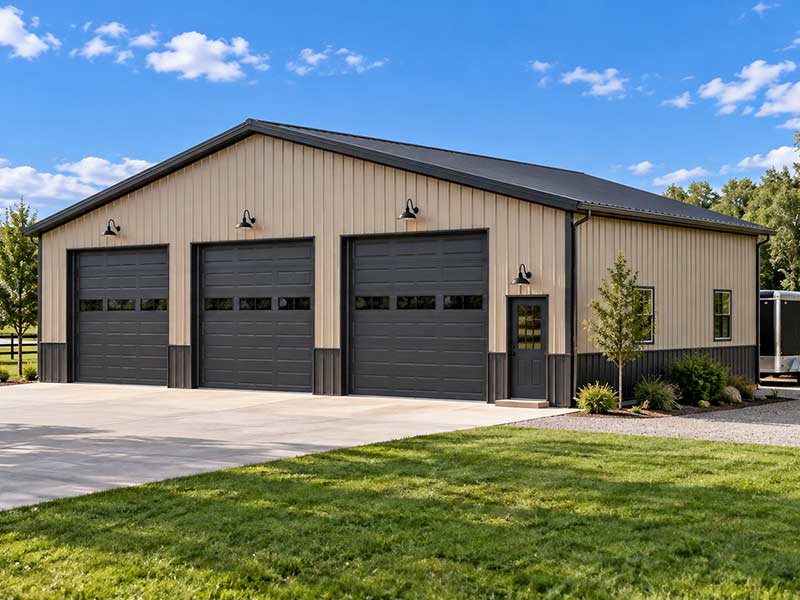
On a rural lot, the shop tends to be the building you use hardest. Decide what it has to hold before anyone draws the house: a truck, a tractor, a boat, a work trailer, a lift, a woodworking setup. Each one sets a door width, a ceiling height and a floor load. A 12-foot door and a 14-foot eave cost little extra on paper and a lot to retrofit.
Then decide how the shop and the house relate. Some owners want the shop close enough to walk to in the rain. Others want it far enough away that a running compressor doesn't carry into the bedrooms. Sketch both on the actual lot, with the driveway, before you settle on either.
Wells, septic and power on open land
Land outside town may rely on a well and a septic system, and the septic field often decides where everything else goes, because it needs suitable soil and room to work. Get the soil evaluated early, and keep the shop's driveway and any heavy equipment traffic off the field.
Power is the other early call. A shop with a welder, an air compressor and heating and cooling can need more capacity than the house. Ask the utility what it will take to bring service to the spot you've chosen, and ask builders whether a separate meter or a subpanel fed from the house makes more sense for your plan.
Before you commit to a layout, confirm current requirements with the City of Haskell's planning office, or with Saline County if the land sits outside the city limits. FEMA's flood maps are worth a look for any parcel with a creek or low corner.
Steel frame or post-frame for a working shop
A red-iron shop uses steel columns and rafters on a concrete foundation. It suits wide clear spans, tall sidewalls, overhead cranes and heavy doors, and the slab is usually poured as part of the job. A post-frame shop sets wood columns in the ground or on piers with trusses overhead. It's often quicker and less costly for a standard shop, and it's easy to insulate between the posts.
Ask each builder which they'd recommend for your size and use, and why. Then ask about the slab itself: thickness, reinforcement, any thickened areas under a lift, and where floor drains go. A shop floor that cracks under a loaded trailer is the kind of problem you can't fix with paint.
Living space in the shop, or a house beside it
A barndominium puts living space inside a shop-style shell, and on a rural lot it can save you building twice. It works best when the living side gets the same attention a house would: insulation, windows, ventilation and sound separation from the work bay.
A separate custom home with a detached shop costs more up front but keeps the two uses apart and can be easier to resell. If you're torn, ask a custom home builder and a shop builder to bid their versions of the same lot. Comparing the two plans tends to settle the question faster than comparing prices alone.
Close to Benton for materials and crews
With almost no commercial businesses in town, most supplies, rentals and subcontractors will likely come from Benton, Bryant or Little Rock. That's a short haul, and it means Benton-based crews can usually reach a Haskell site without much travel. Ask each bidder whether delivery is included, who unloads, and where materials will be stored on site so they stay dry and out of the way.
Commute and school traffic matter here too. Haskell is home to the Harmony Grove School District, so families often weigh the drive to school as well as the drive to work. Time both from any lot you're considering, at the hour you'd actually leave.
Reading a shop bid line by line
Shop bids vary more than house bids because the scope is easier to trim. Check whether each one includes site prep, the slab, gutters, insulation, doors and their openers, walk doors, windows, electrical and permits. One price may cover a finished shop and another only the shell.
Ask for the frame and roof warranty in writing, and ask what is covered for condensation, leaks and door hardware. Tie payments to finished stages of the work.
If you're also looking at land closer to town, our Benton and Bryant pages cover in-town lots and subdivision building.
Who builds around Haskell
No builder on this page is based in Haskell itself. The nearest are in Benton: Ark-La-Tex Shop Builders of Central Arkansas, which builds metal buildings, shops, garages and equipment sheds, plus a Benton company that builds homes, barndominiums and pole barns and another that builds custom homes. Custom home builders from Little Rock, Ward, Jacksonville and Maumelle are listed, along with a Vilonia contractor whose listing covers homes, barndominiums, metal buildings and pole barns. Rounding out the list are pole barn and metal building companies that work statewide.
Narrow the list by asking each for a recent shop or home in Saline County you can see, references, a written scope, the warranty terms, and license status with the Arkansas Contractors Licensing Board.
Sources: Encyclopedia of Arkansas: Haskell (Saline County), City of Haskell: Planning Commission, FEMA Flood Map Service Center, Arkansas Contractors Licensing Board